Before you write an offer on a house in Shelton, there is a question worth asking that has nothing to do with square footage or the kitchen. Where does the water come from, and where does the water go after you flush?
Most buyers assume they already know the answer from the address. Homes near Canal Street or Howe Avenue must be on city water and sewer. Homes out toward White Hills must be on a well and a septic tank. That assumption is wrong often enough that it's worth checking every single time, because guessing wrong doesn't just cost you information. It costs you time on a contract clock that moves faster than the home inspection contingency most buyers already know to plan around.
Three Agencies, Not One
Ask a Shelton seller who handles their utilities and you'll usually get one answer. There are actually three, and they don't overlap.
City water in Shelton runs through Aquarion, a private water utility, not the city government. Sewer lines are maintained by the Shelton Water Pollution Control Authority, known locally as the WPCA, a body created under state statute as a legal entity separate from the city, responsible for over 120 miles of sanitary sewer line and more than 3,300 manholes. Septic systems fall under neither of those. Any question about a septic system in Shelton goes to the Naugatuck Valley Health District, the local health authority with jurisdiction over private wells and septic, not the water department and not the WPCA.
| Utility | Who Handles It | What a Buyer Should Know |
|---|---|---|
| City water | Aquarion, private water utility | Not run by the city, billed and serviced separately |
| Sewer | Shelton Water Pollution Control Authority | Separate legal entity from the city, sets its own connection charges |
| Septic | Naugatuck Valley Health District | Local health authority, not a city department |
For the 2025-2026 fiscal year, the WPCA set its sewer use rate at $260 per unit for single-family and two-to-four family properties connected to the system, a fixed annual cost that a septic property simply doesn't carry. What a septic property has instead is a periodic pump-out cost and, eventually, a full system replacement. Real expenses, but they don't show up as a recurring line item the way a sewer bill does.
The Subdivision That Breaks the Rule
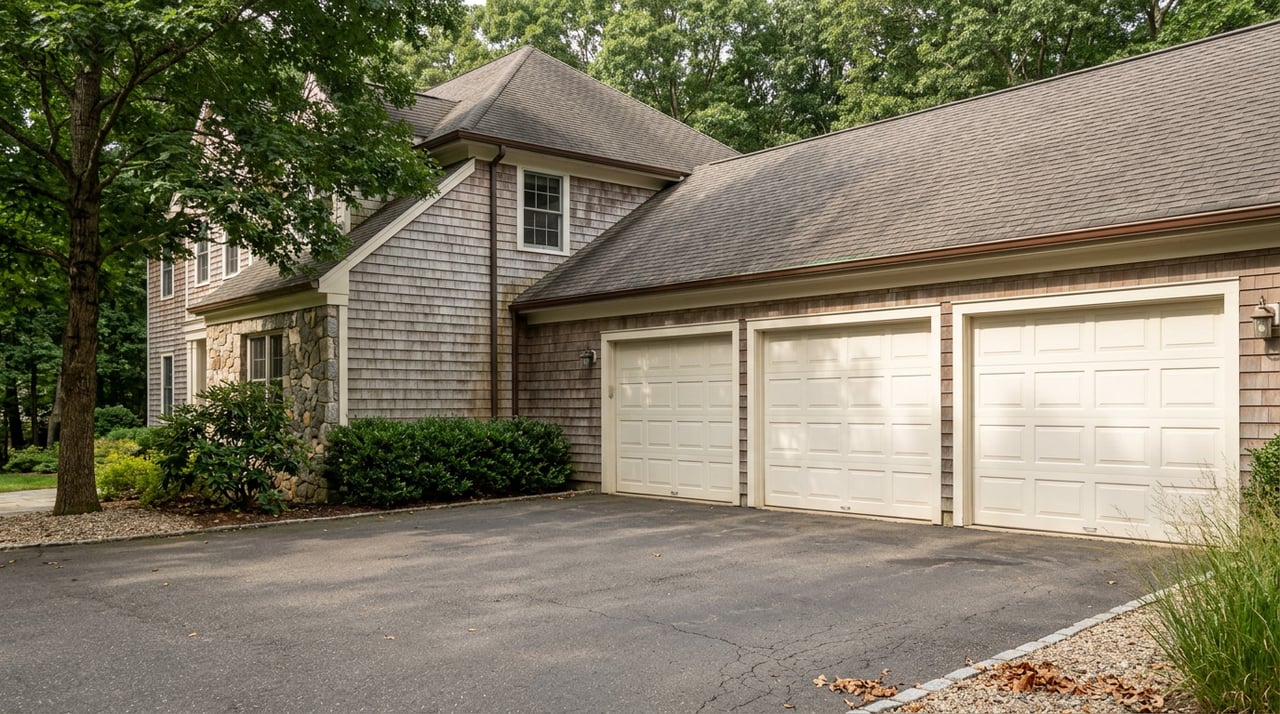
If you're guessing utility type by neighborhood, White Hills is where that guess gets complicated fastest. The Vistas at White Hills, a subdivision built between 2005 and 2007, is a good example. These are large homes, several thousand square feet with three-car garages and finished walkout basements, built on a combination that surprises people who assume rural Shelton means fully private systems: city water paired with septic. The water comes from Aquarion. The waste doesn't go to a WPCA sewer line. It goes to a leaching field on the property.
That combination means a buyer touring a White Hills listing can't infer the septic answer from the presence of city water, and can't infer the water answer from the size or age of the house. The only way to know for certain is to ask, in writing, before the utility question becomes part of the contract.
What the Well and Septic Rider Actually Locks In
If either the water or the waste system on a property you're buying is private, your purchase contract in Connecticut will include a Well and Septic Rider, a standard addendum used statewide. It's worth reading closely before you sign, because it assigns costs and deadlines that differ from your regular home inspection contingency.
Here's what the rider typically requires:
- The buyer arranges and pays for the well inspection, including a yield test, with a report due back within a negotiated number of days after the contract is fully executed.
- If the septic system was pumped within six months before the inspection date, the buyer pays to have it pumped again if that's necessary to actually inspect it.
- If the Connecticut Public Health Code requires a riser added to the septic tank so it can be properly inspected, that cost typically falls on the seller.
- If either inspection turns up a problem, the buyer usually has just three days after receiving the report to give the seller written notice and try to reach an agreement on repairs before losing the right to walk away over that issue.
- If the property has a private or semipublic well, the buyer must acknowledge in writing that they've received the state's educational materials on well testing, a disclosure written into Connecticut law under General Statutes Section 19a-37(d).
The part that catches buyers off guard isn't the cost. It's the clock. Once the contingency date on the rider passes without written notice, the seller has no further obligation on that issue.
Private wells in Connecticut also carry no ongoing inspection requirement from the state after they're built. A well can develop a slow decline in yield or a failing pump for years without anyone knowing, because nobody checks unless a sale triggers it. That's why the rider exists, and why skipping the well inspection to save a few hundred dollars is a bad trade on a system nobody has tested since it was installed. A mechanical well inspection and a water quality test for things like bacteria and nitrates are also two separate steps, not one, and Connecticut recommends both before closing on a property with a private well.
The Other Number Nobody Quite Agrees On
Utility type isn't the only thing in Shelton that looks simple from the outside and isn't. Ask what the median home price is this summer and you'll get a different number depending on which aggregator you check. Listing sites tracking Shelton through the summer of 2026 have shown median list prices ranging from the high $500,000s to the low $600,000s within the same few months, while separate measures of median sale price over the trailing twelve months land closer to the mid $500,000s. Days on market for the same stretch has ranged from under three weeks to close to seven weeks, depending on whether the source is measuring new listings, active inventory, or closed sales.
None of those figures is wrong exactly. They're measuring different slices of the same market and reporting each one with the same confident precision, which is the same trap the well-versus-sewer guess falls into. A number that looks exact from a distance often needs one more question before it tells you anything useful about the specific house in front of you.
Before You Write the Offer
If you're serious about a Shelton house that isn't clearly on public water and sewer, ask the listing agent directly, in writing, whether the property is served by a private well, a septic system, or both, before you get anywhere near the offer stage. If the answer is vague or the seller hasn't disclosed it plainly, build enough time into your contingency dates to get a real well inspection and a real septic evaluation done, not just a walkthrough. And if the house sits in a subdivision you assume is either fully municipal or fully private, verify it anyway. White Hills has already proven that assumption wrong at least once.
If you want a sense of what's currently on the market across town, our Shelton neighborhood page is a reasonable place to start. And if you're weighing daily life in Shelton as much as the paperwork, our recent look at the Canal Street corridor and White Hills farm country covers the parts of town this post doesn't.
A Few Questions Worth Asking Directly
Does a well inspection tell you if the water is safe to drink? Not entirely. A mechanical well inspection checks the pump, pressure, and physical components. Water quality testing for bacteria, nitrates, and other contaminants is a separate test, and Connecticut recommends both before closing on a property with a private well.
Who pays for the septic pump-out during inspection? Under the standard rider, the buyer covers it if the tank hasn't been pumped in the six months before the inspection date. If it was pumped more recently, that cost typically isn't triggered.
Can I skip the well or septic portion of the rider if the house only has one of the two? No. Whichever system is private, the corresponding section of the rider applies. A property with city water and a septic tank, like homes in the Vistas at White Hills, still needs the septic portion of the rider even though the water side is municipal.
If you're looking at a property in Shelton and want a straight answer on what's actually running underneath it before you write an offer, working with a buyer's agent who knows to ask these questions early can save you a week of back and forth once you're under contract. Our team, led by longtime Fairfield County agent Mary Beth Grasso, walks buyers through exactly this kind of underneath-the-surface question before it becomes a deadline problem.
Grasso Team is ready to talk through the utility question, the timeline, and the paperwork with you from the first showing through closing. Contact us before you're staring down a contingency deadline you didn't know existed.